Foil, epee, or sabre: Which fencing weapon should you start with? (an honest answer)
If you’ve spent any time on fencing forums asking which weapon to start with, you already know the script. Someone posts a comparison table. Someone else tells you to “pick the one that fits your personality.” A third person says all three are great and you can’t go wrong. You close the tab no closer to a decision than when you opened it.
We’re going to do this differently.
The honest answer to “which weapon should I start with” isn’t really about the weapons. It’s about something most posts won’t tell you — and once you know it, the choice gets a lot easier.
The short answer: the coach and the commute matter more than the weapon
For beginners, the weapon matters less than the coach and the commute.
That’s the answer most fencers land on after years in the sport, and it’s the one we’d give a friend asking us in person. The right club — meaning a coach you trust, a community you’d actually want to spend time in, and a location you can get to without resenting the trip — will turn you (or your kid) into a real fencer regardless of which weapon they specialize in. The wrong club won’t, no matter how “perfect” the weapon match looks on paper.
That said, there are real differences between foil, epee, and sabre, and understanding them helps you walk into a trial class knowing what you’re looking at. So we’ll cover the three weapons honestly, give you a decision framework that actually works, and tell you what we teach and why. By the end you’ll either know which weapon you want to try first — or you’ll know it doesn’t matter as much as you thought, which is the real win.
What’s actually different about foil, epee, and sabre
Three weapons, three completely different sports under the same roof. Here’s the at-a-glance version before we get into how each one actually feels.
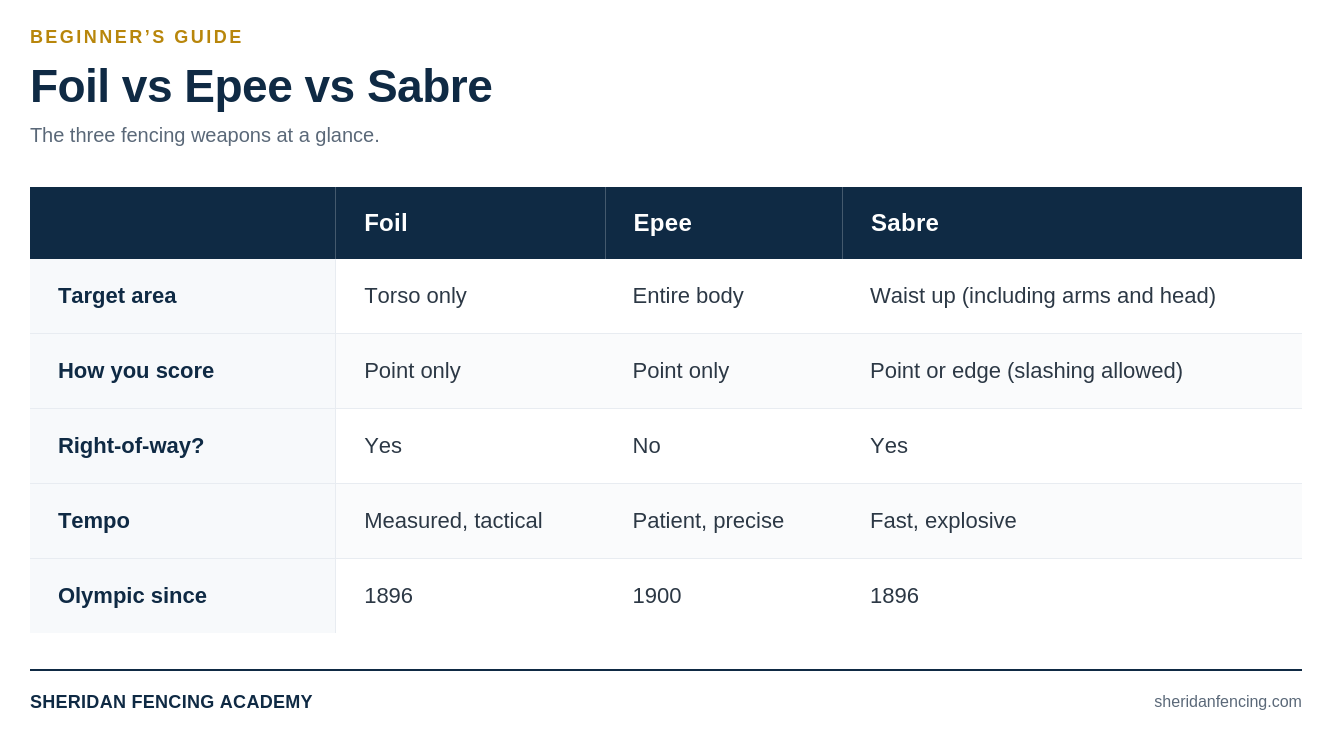
Right-of-way is the rule that decides who gets the point when both fencers hit at the same time. In foil and sabre, the fencer who attacked first (or correctly defended) wins the touch. In epee, simultaneous hits just mean both fencers score. That single rule difference shapes almost everything else about how the three weapons feel to fence.
How foil fencing actually feels: the chess game of fencing
Foil is the chess game of fencing. The target area is just the torso, which sounds limiting until you realize it forces both fencers into a constant tactical conversation about who has the right to attack and who has to defend. Every action is a setup for the next one. A foil bout at a high level looks like two fencers reading each other’s intentions three moves ahead.
People who gravitate toward foil tend to enjoy the puzzle of it. The patience required to set up a touch, the discipline of giving up right-of-way to bait an opponent, the satisfaction of executing a plan that started thirty seconds earlier. It’s the most “traditional” of the three weapons in feel, descended pretty directly from classical European fencing schools.
If you’ve watched fencing in the Olympics and thought “that looks elegant and a little hard to follow,” you were probably watching foil.
How epee fencing actually feels: patience and precision
Epee is the most democratic of the three weapons. Whole body is target. No right-of-way. If you hit your opponent and they hit you a fraction of a second later, you both score. There’s no referee deciding who “deserved” the touch.
That changes everything. Epee fencers tend to be patient, analytical, and willing to wait. A bout can stay still for long stretches while both fencers refuse to commit, then explode into a single clean action that decides the point. Toe touches are legal and common. So are wrist touches, which sounds minor until you realize the wrist is the closest target on an extended arm and small, fast hand actions become the entire game.
Epee is often the weapon that draws older beginners and analytical adults. The lack of right-of-way means you don’t have to memorize a complicated tactical hierarchy to start scoring touches, and the patience-rewards-patience nature of the bouts suits people who’d rather think than sprint. It’s the weapon most associated with traditional dueling, and it still has some of that flavor.
How sabre fencing actually feels: speed and explosive athleticism
Sabre is the fastest weapon. Target is everything from the waist up. You can score with the point or with the edge, which means slashing actions count, which means bouts move at a pace that genuinely surprises people seeing it for the first time. Touches happen in fractions of a second. A full bout to fifteen points can be over in a few minutes.
Sabre rewards explosive athleticism, fast decision-making, and a willingness to commit. Right-of-way exists, like in foil, but the speed of the weapon means tactical setups happen in tighter windows. You’re not playing a thirty-second chess match — you’re reading your opponent in the moment of an attack and responding before they finish it.
This is the weapon most kids in the US start with, and there are real reasons for that. It’s the most spectator-friendly (parents watching their first sabre bout can actually tell what happened, which is not always true of foil). It rewards the kind of athleticism young kids are already developing. And it’s the fastest path to the part of fencing that feels most like fencing — the back-and-forth, the attacking, the moments of pure speed.
It’s also the weapon Jason Sheridan, our founder, has spent his career coaching. He’s the first American-born coach in history to train a World Champion in sabre, and the methodology we use across all three of our locations comes out of decades of figuring out how to teach this specific weapon well to American kids and adults.
How to actually choose your first fencing weapon
Here’s the framework that actually works, in order of importance.
First, what’s accessible to you. What clubs are within a reasonable commute? What weapons do they teach? A great club teaching sabre twenty minutes from your house will produce a better fencer than a mediocre club teaching your “ideal” weapon an hour away. The commute matters more than people realize, especially for kids — a sport you can get to twice a week is one you’ll actually stick with.
Second, who’s coaching. Specialization is a feature, not a limitation. Most serious US fencing clubs go deep on one or two weapons because depth produces quality. A club that teaches all three weapons equally well is rare. A coach who’s spent twenty years teaching sabre will turn a beginner into a fencer faster than a coach splitting attention across three weapons. When you visit a club, ask what they specialize in and why.
Third, temperament — but only as a tiebreaker. If you have two equally good options nearby, then yes, the foil-feels-tactical, epee-feels-patient, sabre-feels-explosive thing is real and worth weighing. Kids who love speed often love sabre. Adults who love analysis often love epee. People who love the puzzle of it often love foil. But this is a tiebreaker, not a starting point.
The thing nobody tells beginners: most of the foundational skills transfer. Footwork, blade awareness, distance, timing, the mental game of reading an opponent. Fencers who switch weapons later (and many do) don’t start over. They adapt. So the cost of “picking wrong” is much lower than it feels when you’re standing at the start.
What we teach at Sheridan Fencing Academy, and why
We teach sabre at all three of our locations: Manhattan, Forest Hills, and Mamaroneck. Our Manhattan location also offers foil and epee for adult fencers.
We didn’t end up here by accident. Jason built the academy around sabre because that’s the weapon he’s spent his career mastering as a coach, and we kept it focused because we’d rather be excellent at one thing than average at three. The athletes who’ve come through our program — World Cup medalists, NCAA champions, Junior Olympic champions, fencers recruited to Harvard, Princeton, Brown, UPenn, MIT, Yale — got there because the training was deep, not broad.
For adults specifically, our Manhattan location offers all three weapons because adult fencers often come in with a clearer sense of what they want and benefit from the choice. Kids and teens train in sabre because that’s where we can give them the most.
If you’re trying to decide between weapons and you’re in the NYC metro, the most useful thing we can tell you is: come try a class. Free for kids, $25 for adults. You’ll learn more in forty minutes on the strip than you will in another hour of reading.
Frequently asked questions about choosing a fencing weapon
Can I switch fencing weapons later if I change my mind?
Yes, and many fencers do. The foundational skills — footwork, distance, timing, blade awareness, the mental game of reading an opponent — transfer across all three weapons. You won’t start over if you switch. You’ll adapt. We’ve seen kids start in sabre and explore epee as adults, and adults pick up a second weapon after years of training. The “wrong choice” worry is much smaller than it feels at the start.
Which fencing weapon is best for college recruiting?
None of them, specifically. NCAA fencing programs recruit across all three weapons because most college teams field fencers in all three. What matters far more than weapon choice is the depth of your training, your competitive results, and your relationship with a coach who can advocate for you. Our athletes have been recruited to Harvard, Princeton, Brown, UPenn, MIT, Yale, and other top programs as sabre fencers — but the path to recruitment was about the training, not the weapon.
Is sabre really the easiest fencing weapon for kids to start with?
“Easiest” isn’t quite the right word. Sabre is the most intuitive for kids because it rewards the athleticism they’re already developing — speed, explosiveness, quick decision-making — and because the bouts are visually clear in a way that keeps fencing lessons engaging. Most US clubs start kids in sabre for these reasons, and we do too. That doesn’t mean sabre is “easy” at higher levels. It means the entry ramp is forgiving and the early progress feels real, which keeps kids motivated to keep training.
Does fencing equipment cost more for one weapon than another?
Costs are roughly similar across all three weapons at the beginner level. The basics — mask, jacket, glove, weapon, body cord — are comparable in price whether you’re fencing foil, epee, or sabre. Some specialized electric scoring gear varies slightly, but it’s not a meaningful factor in choosing a weapon. Don’t let equipment cost drive the decision.
Which fencing weapon is most popular in the US?
All three are well-represented, but sabre has grown significantly in the US over the past two decades, particularly among kids and youth fencers. Foil remains the most popular weapon globally. Epee has a strong adult following in the US. In the NYC metro specifically, there are excellent clubs across all three weapons — but most clubs specialize, which is why your local options matter more than national statistics.
Try a free fencing class at Sheridan Fencing Academy
Three locations across the NYC in Upper East Side Manhattan, Forest Hills Queens, and Mamaroneck Westchester. Free trial classes for kids at all three. $25 trial for adults at our Manhattan location, which also offers foil and epee.